The Short Answer
Morocco has two official languages: Arabic and Tamazight (Berber). In daily life, most Moroccans speak Darija, a Moroccan dialect of Arabic that is not really understood outside the Maghreb. French is everywhere in business, government and education. Spanish is common in the north (Tetouan, Tangier, Chefchaouen). English is now the third foreign language and is spreading quickly, especially among Moroccans under 30 working in tourism.
If you speak any French at all, you will be fine almost anywhere. If you speak only English, you will still manage in tourist areas without much friction.
The Two Official Languages
Arabic (and Darija)
Classical Arabic (Fusha) is the language of the constitution, the news, religious sermons and most printed material. Almost no one speaks it casually. What Moroccans actually speak among themselves is Darija, a fast, slangy dialect that blends classical Arabic with Tamazight, French and Spanish loanwords.
Egyptians, Saudis and Lebanese often say they cannot understand Darija. That gives you a sense of how distinct it is. If you have learned Modern Standard Arabic in a classroom, you will read signs fine but you will struggle to follow a conversation in the souk.
Tamazight (Berber)
Tamazight is the indigenous language of North Africa, spoken in Morocco long before Arabic arrived in the 7th century. It became an official language alongside Arabic in the 2011 constitution. Roughly a third of Moroccans speak one of its three main variants: Tarifit in the north (Rif mountains), Tamazight in the Middle Atlas, and Tashelhit in the south (Souss, Anti-Atlas, parts of the desert).
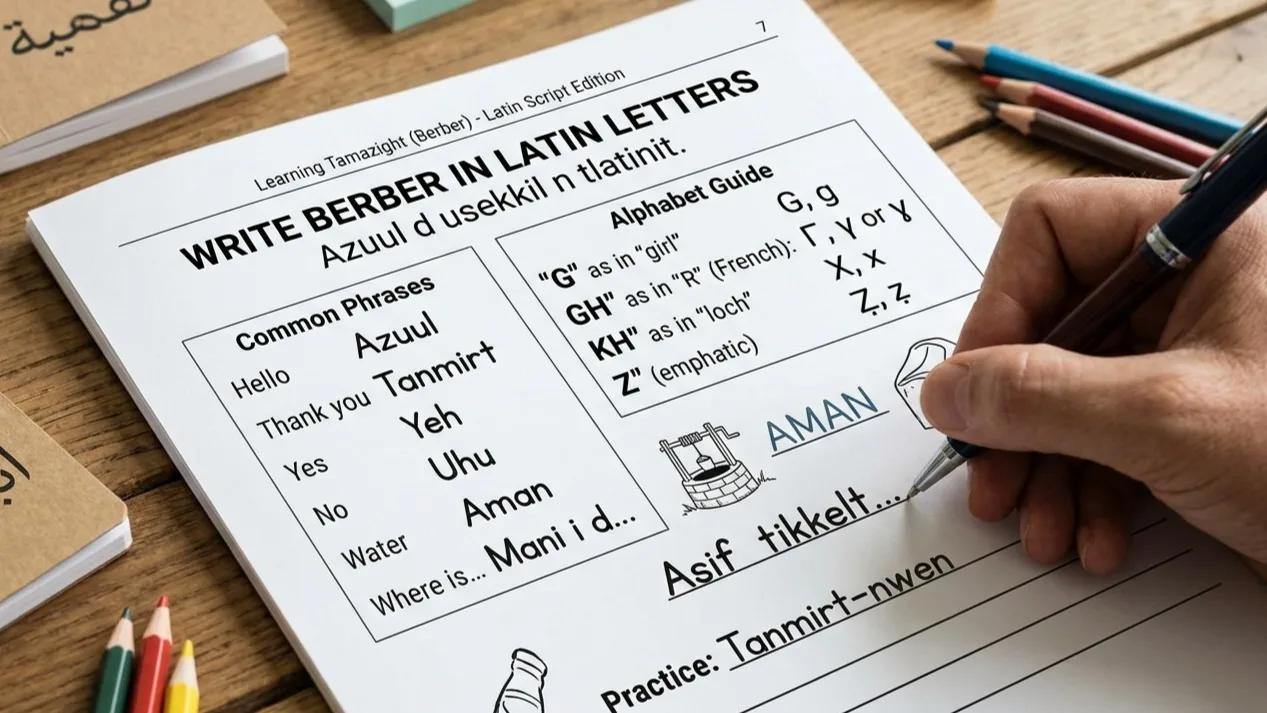
You will see Tamazight on official signs, written in its own script (Tifinagh) alongside Arabic and French. In the High Atlas, the desert and the Souss valley, it is the language you will hear in the home.
The Working Languages
French
France ruled the Moroccan protectorate from 1912 to 1956, and the linguistic legacy is enormous. French is not official but it is the language of business, banking, higher education, medicine, science and most upscale restaurants. Menus in cities are often only in French and Arabic. Many educated Moroccans switch effortlessly between Darija and French in the same sentence.
For a traveller, knowing even basic French (bonjour, merci, l'addition, combien) makes daily life much smoother.
Spanish
In the cities of northern Morocco (Tangier, Tetouan, Chefchaouen, Larache, Nador, Al Hoceima), Spanish is widely understood. Spain held a protectorate over the north from 1912 to 1956 and still controls the enclaves of Ceuta and Melilla. TV from Spain is watched daily. If you speak Spanish, the north of Morocco is more comfortable for you than the south.
English
English is now the most studied foreign language in Moroccan schools after French. Anyone under 30 working in a riad, a tour office, a cafe or a museum will speak workable English. Older shopkeepers in the medina often have memorised the English they need to sell to tourists, sometimes alongside German, Italian and a few Japanese phrases.
You will not have a real conversation in English with a 60 year old taxi driver in a small town. But ordering food, asking for directions and booking a tour is fine in English in Marrakech, Fes, Casablanca, Rabat, Tangier, Essaouira and Chefchaouen.
What You Actually Hear on the Street
Walk through Jemaa el Fna in Marrakech on an average evening. You will hear:
- Moroccans speaking Darija to each other, with French numbers and the occasional Spanish word thrown in.
- Berber families from the Atlas speaking Tashelhit.
- Tour guides switching between French, English and Spanish depending on their group.
- Hospitality staff greeting Gulf Arabs in classical Arabic, French tourists in French, Brits and Americans in English.
A senior waiter in a Marrakech riad might use five languages in one shift without thinking about it.
Useful Words for Travellers
A few words go a long way. Moroccans appreciate even the smallest effort.
| English | Darija (Moroccan Arabic) |
|---|
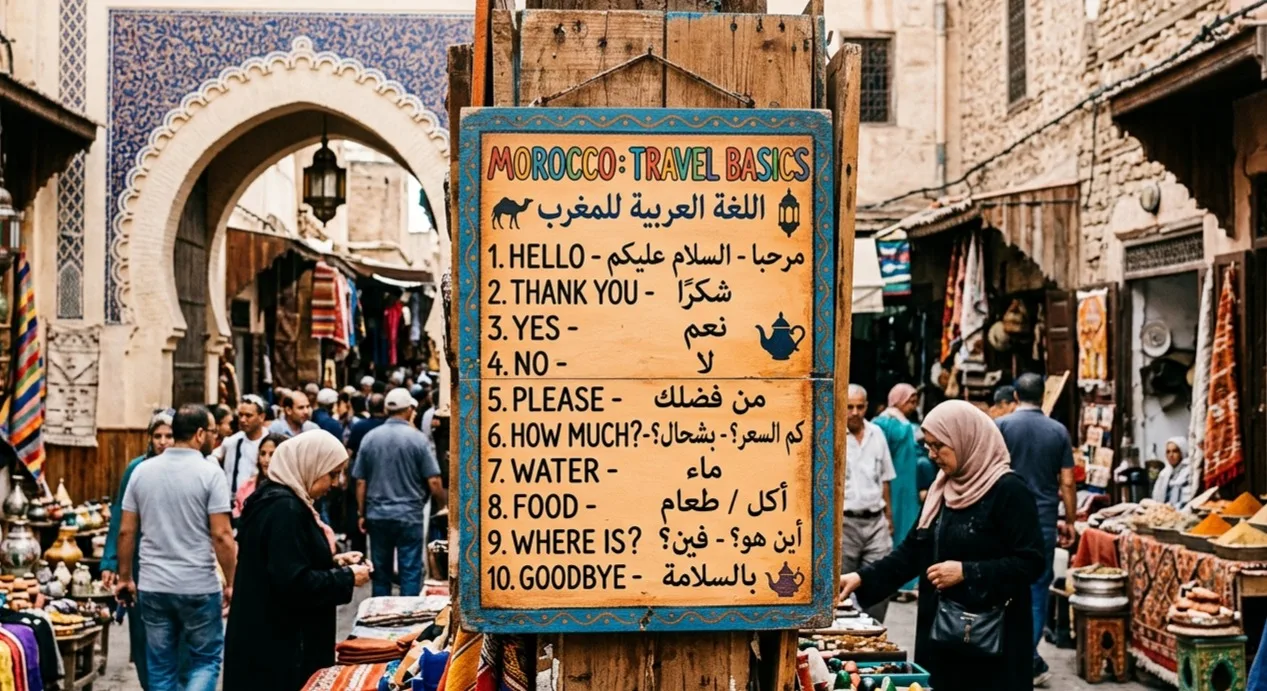
Image
If you are in a Berber region (Atlas mountains, desert):
And the universal Moroccan word you will use ten times a day: Inshallah. "If God wills." It means yes, maybe, probably, eventually, or never. Context will tell you which.
Will the Language Barrier Be a Problem?
For most travellers, no. In tourist areas (medinas of Marrakech, Fes, Chefchaouen, Essaouira; the desert tours; coastal resorts), English is enough to do everything you need. Outside those areas (rural Atlas villages, small towns in the Rif, deep desert), some French helps enormously. A few phrases of Darija or Tamazight will get you smiles wherever you go.
The one place where language can be a real friction point is dealing with police, hospitals or administrative offices. There, French is the working language. If you ever need to file a report or visit a clinic, having a French-speaking guide or hotel manager call ahead is the easiest path.
A Quick Note on Reading Signs
Most road signs are in Arabic and French (and Tamazight in officially trilingual zones). Latin transliterations of Arabic place names vary wildly. "Marrakesh" and "Marrakech", "Fez" and "Fes", "Tangier" and "Tanger", "Essaouira" and "Es-Saouira" are all the same places. GPS apps handle this. Paper maps will surprise you.
Final Thoughts
Morocco is one of the most multilingual countries you will ever visit. It is normal for a Moroccan to grow up speaking Darija at home, learn French and classical Arabic at school, watch Spanish TV, study English from age 10, and pick up Italian or German from years of working with tourists. Do not stress about your phrasebook. Bring a few Darija words, smile, and let people meet you halfway. They always do.
FAQ
What is the main language spoken in Morocco
The main spoken language is Darija, the Moroccan dialect of Arabic. About 90 percent of Moroccans speak it fluently. Standard Arabic is the official written form, and Tamazight (Berber) is the indigenous language spoken by about a third of the country, especially in the Atlas mountains and the south.
Do Moroccans speak French
Yes, widely. French is the de facto working language of business, banking, education and government, a legacy of the 1912 to 1956 French protectorate. Most educated Moroccans speak fluent French, and many switch between Darija and French in the same conversation.
Do they speak English in Morocco
English is the third foreign language after French and Spanish, and it is growing fast. Almost everyone under 30 in the tourism industry speaks workable English. In the medinas of Marrakech, Fes, Chefchaouen and Essaouira, you can travel comfortably with English alone. In rural areas, French is more useful.
What language is spoken in Marrakech
Marrakech is mostly Darija (Moroccan Arabic) speaking, with Tashelhit Berber widely spoken by people who moved in from the surrounding Souss and High Atlas regions. French is used in restaurants, hotels and shops. English is common in the medina and tourist quarters.
Is Moroccan Arabic the same as Arabic
No. Moroccan Arabic (Darija) is a distinct dialect that blends classical Arabic with Berber, French and Spanish vocabulary. Speakers of Arabic from Egypt, Saudi Arabia or Lebanon often say they cannot follow a Darija conversation. Written Arabic, which Moroccans also use, is the same as in other Arab countries.
How do you say hello in Moroccan
The most common greeting is Salam, short for As-salamu alaykum (peace be upon you). The reply is Wa alaykum as-salam. In Berber-speaking areas, Azul is the equivalent. Both are appreciated by locals when used by visitors.