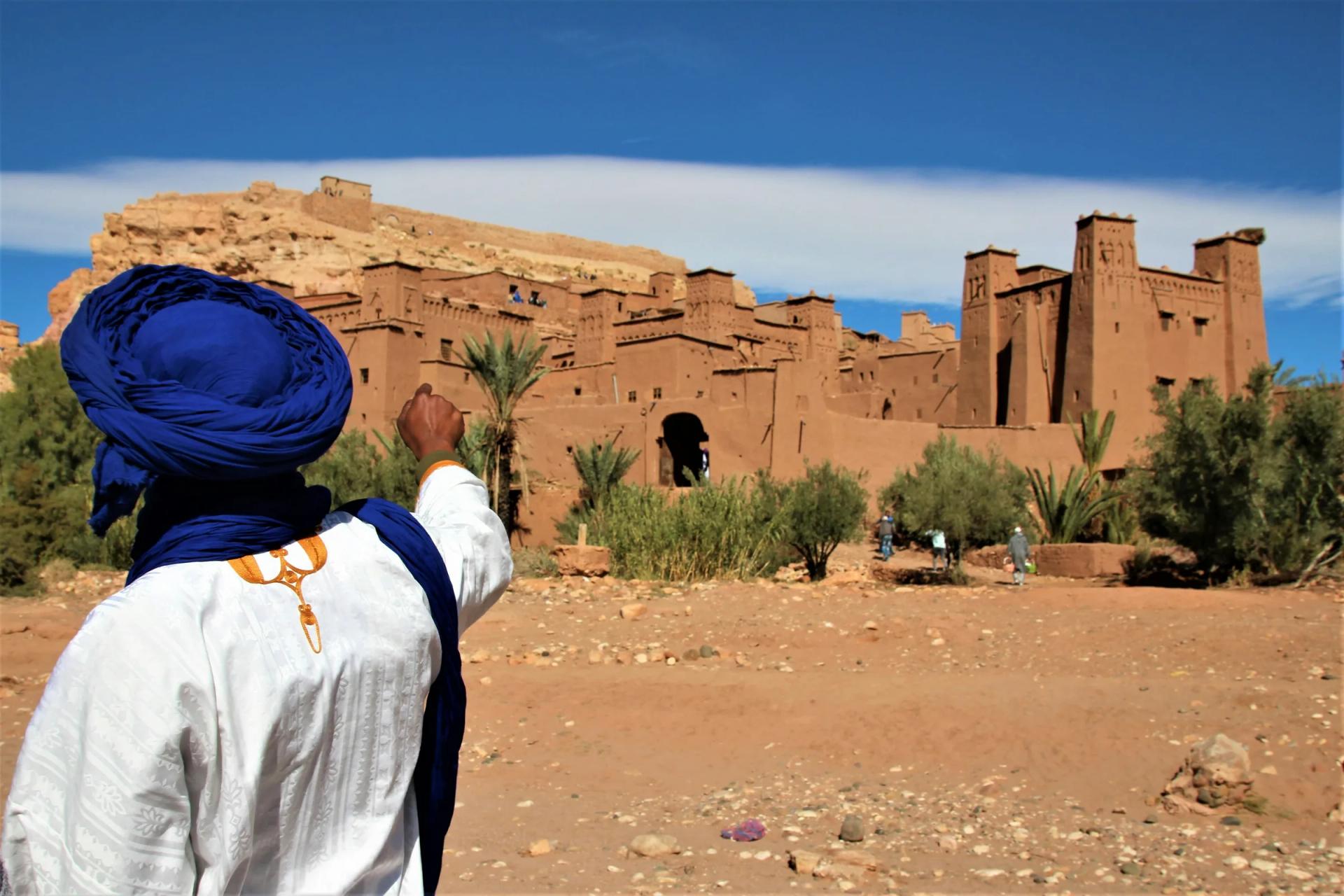
Morocco Grand Tour: 10 Days from Casablanca to Marrakech
Free cancellation
Cancel up to 7 days in advance for a full refund
Meeting point
Aéroport Mohamed 5, Casablanca 20650, Morocco
Duration: 10 days
Check availability to see starting times
Live tour guide
English, Spanish, French
Moderate activity
Some walking or physical effort involved
Small group
Limited to 6 participants
About this experience
A 10-day private journey across Morocco, from the Atlantic coast to the Sahara, in your own air-conditioned vehicle with a private driver. Start in Casablanca and drive through Rabat and the Rif Mountains to Chefchaouen, the blue pearl of the north, with a full day to enjoy it at your own pace. Continue to the Roman ruins of Volubilis and the imperial city of Meknes, then discover Fes on a guided tour of its thousand-year-old medina. Cross the Middle Atlas via Ifrane and the cedar forest, descend the Ziz Valley and spend a night in a desert camp at Merzouga. Travel on through Rissani, the Todra Gorges and the Dades Valley, then follow the road of the kasbahs through Skoura and Ouarzazate to the UNESCO ksar of Ait Ben Haddou. Finish by crossing the High Atlas over the Tizi n'Tichka pass to Marrakech, with a guided tour of the Red City on your last day. Included: accommodation with daily breakfast, private transport with an English-speaking driver, licensed local guides in the main cities, entrance fees for the included sites, a camel trek and a night in a desert camp, private airport transfers and 24/7 support.
Difficulty
Moderate
Accommodation
Mixed
Meals included
Day-by-day itinerary
- D1
Day 1 · Casablanca
Day 1: Arrival in Casablanca
Your Moroccan adventure begins the moment you land in Casablanca, the country's largest city and its beating economic heart. Your private driver will be waiting to welcome you at Mohammed V International Airport and transfer you comfortably to your hotel. Depending on your arrival time, you may visit the magnificent Hassan II Mosque, one of the largest mosques in the world and among the very few in Morocco open to non-Muslim visitors. Rising directly above the Atlantic Ocean, its 210-meter minaret is the tallest in Africa, and its prayer hall, adorned with hand-carved cedar, intricate zellige tilework, and marble from across Morocco, can hold 25,000 worshippers. Waves crash against the rocks beneath its glass-floored sections, a breathtaking introduction to Moroccan craftsmanship. Time permitting, enjoy a stroll along the Corniche seafront promenade or through the Art Deco boulevards of the city center, a legacy of Casablanca's French colonial era. Overnight in Casablanca.
HotelBreakfast - D2
Day 2 · Chefchaouen
Day 2: Casablanca to Rabat, the Rif Mountains & Chefchaouen
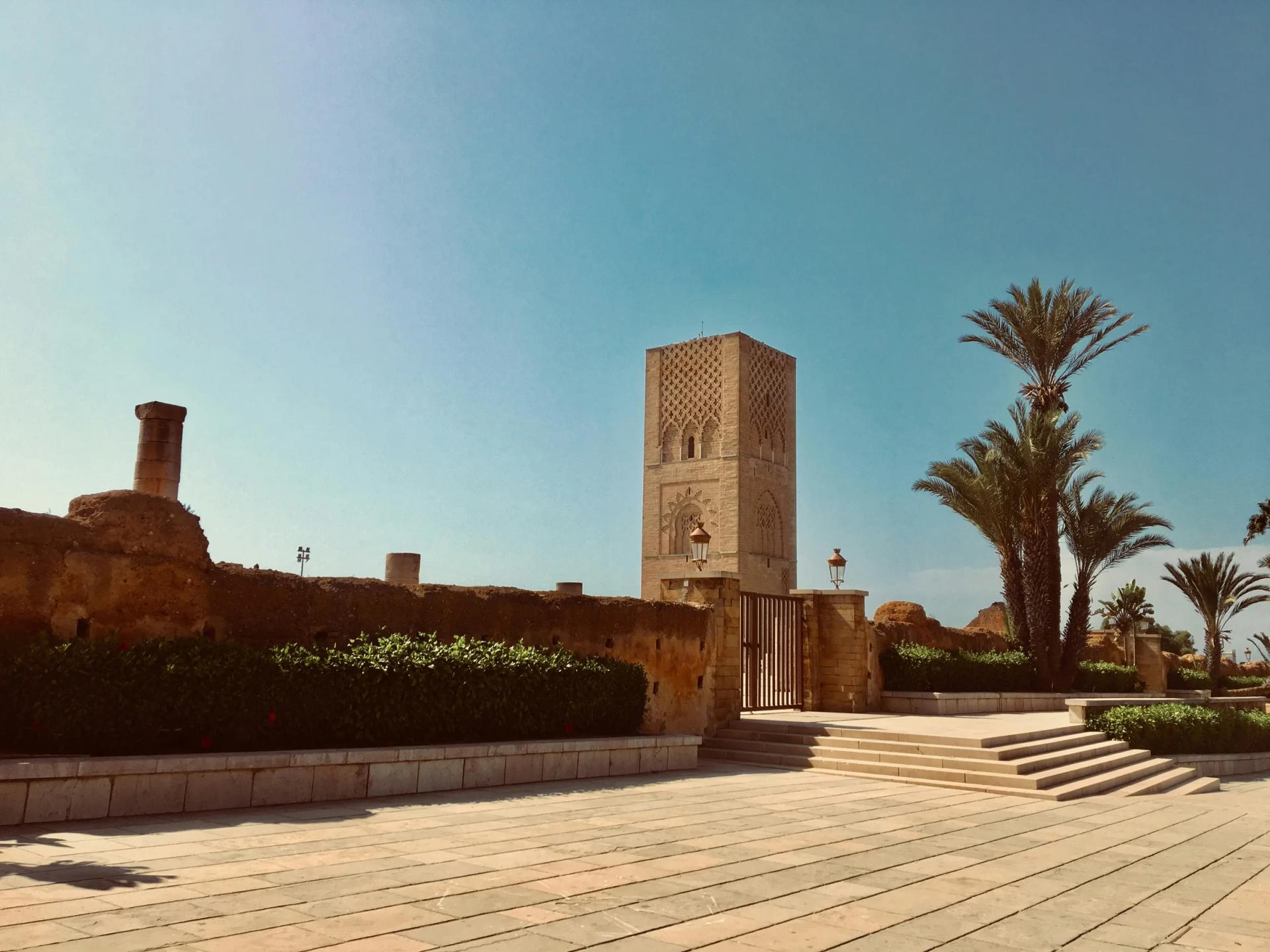
After breakfast, we drive north along the Atlantic coast to Rabat, Morocco's elegant capital and a UNESCO World Heritage city where royal history and modern government coexist gracefully. Here you will discover the Hassan Tower, the striking 12th-century minaret of an unfinished mosque that was intended to be the largest in the world; the adjacent Mausoleum of Mohammed V, a masterpiece of modern Alaouite architecture where royal guards in ceremonial dress watch over the tombs of the late king and his sons; and the Kasbah of the Udayas, a fortified citadel dating to the 12th century, whose blue-and-white lanes, Andalusian gardens, and ocean-view terrace overlook the mouth of the Bouregreg River and the Atlantic beyond. Leaving the coast behind, the road climbs steadily into the green folds of the Rif Mountains, passing olive groves, cork oak forests, and hillside villages. In the late afternoon we arrive in Chefchaouen, Morocco's famous "Blue Pearl," a mountain town founded in 1471 who
GuesthouseBreakfast - D3
Day 3 · Chefchaouen
Day 3: Chefchaouen at Leisure
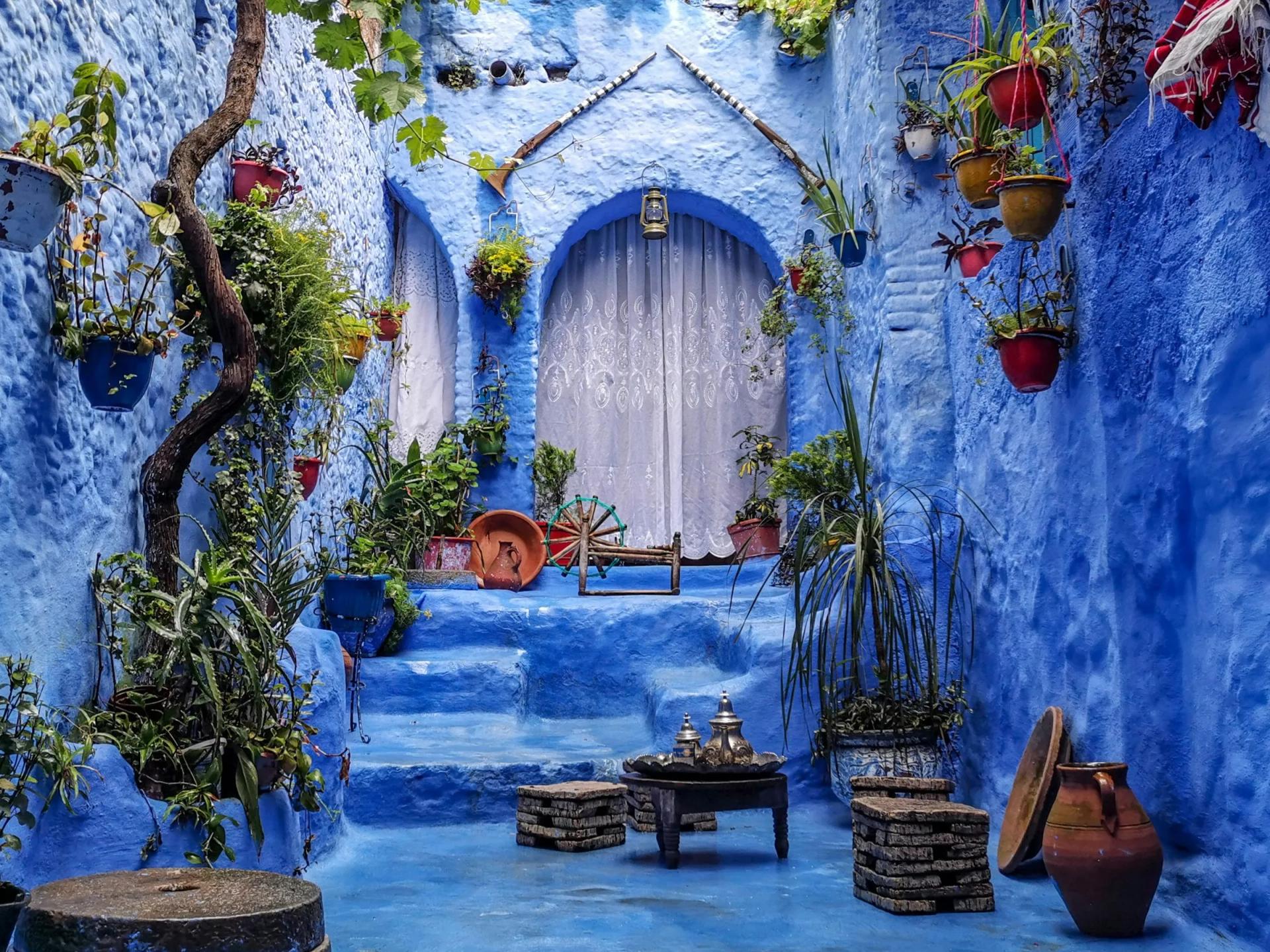
Today is dedicated entirely to one of the most photogenic towns on earth. After breakfast, set out to explore Chefchaouen at your own relaxed pace. Wander the maze of powder-blue alleyways of the medina, where cascading flowerpots, hand-woven blankets, and painted doors create a picture at every turn. Browse the artisan workshops and small markets around Place Outa el-Hammam, the cafe-lined main square dominated by the earthen walls of the 15th-century kasbah and the Grand Mosque with its unusual octagonal minaret. For the more active, a gentle walk leads to Ras el-Maa, the mountain spring at the edge of the medina where locals still gather to wash wool and chat, and onward up to the Spanish Mosque, whose hilltop terrace offers the most beautiful panoramic view of the blue town spread across the flank of the Rif Mountains, especially magical at sunset. Chefchaouen is also renowned for goods found nowhere else in Morocco: wool garments, woven blankets, and locally made goat cheese.
GuesthouseBreakfast - D4
Day 4 · Fes
Day 4: Chefchaouen to Volubilis, Meknes & Fes
After breakfast we head south out of the Rif toward the fertile plains of Saiss, arriving at the extraordinary Roman ruins of Volubilis, a UNESCO World Heritage Site and the best-preserved ancient city in Morocco. Founded in the 3rd century BC and later the westernmost outpost of the Roman Empire, Volubilis flourished on olive oil and trade. Today you can walk its Decumanus Maximus past the triumphal Arch of Caracalla, the columns of the Capitoline Temple, and the grand houses of wealthy merchants, whose remarkably intact floor mosaics depicting Orpheus, Hercules, and scenes of daily Roman life still glow with color under the open sky, framed by rolling wheat fields and the sacred hill town of Moulay Idriss in the distance. We continue to Meknes, one of Morocco's four imperial cities and the 17th-century capital of the mighty Sultan Moulay Ismail, who surrounded it with some 40 kilometers of ramparts. Admire the monumental Bab el-Mansour, widely considered the most beautiful gateway i
RiadBreakfast - D5
Day 5 · Fes
Day 5: Fes Guided City Tour
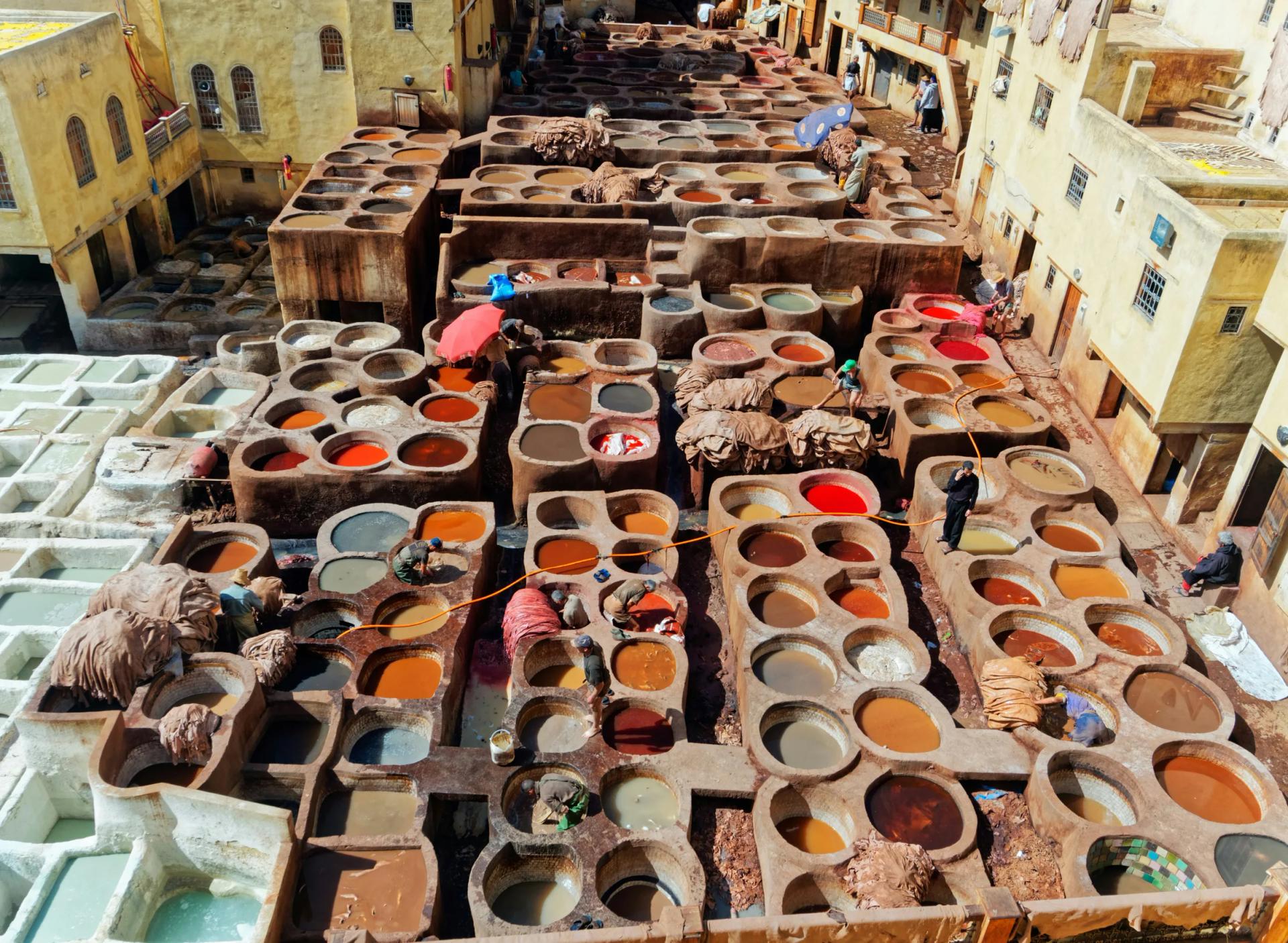
Today you explore the oldest and most fascinating of Morocco's imperial cities in the company of an expert local guide, essential for unlocking the secrets of a medina with more than 9,000 winding lanes. Fes el-Bali, founded in the 9th century and a UNESCO World Heritage Site, is the largest car-free urban area in the world; donkeys and handcarts still carry goods through its labyrinth as they have for over a thousand years. Highlights of your walking tour include the Al-Qarawiyyin Mosque and University, founded in 859 AD and recognized as the oldest continuously operating university on earth; the beautifully restored Medersa Bou Inania and Medersa el-Attarine, 14th-century Quranic colleges showcasing the finest carved cedar, stucco, and zellige work in Morocco; and the famous Chouara Tanneries, where leather is still dyed in honeycombs of stone vats using medieval methods, best viewed from the surrounding terraces. Your guide will lead you through the souks.
RiadBreakfastDinner - D6
Day 6 · Sahara desert camp
Day 6: Fes to Ifrane, the Cedar Forest, Midelt, the Ziz Valley & Merzouga
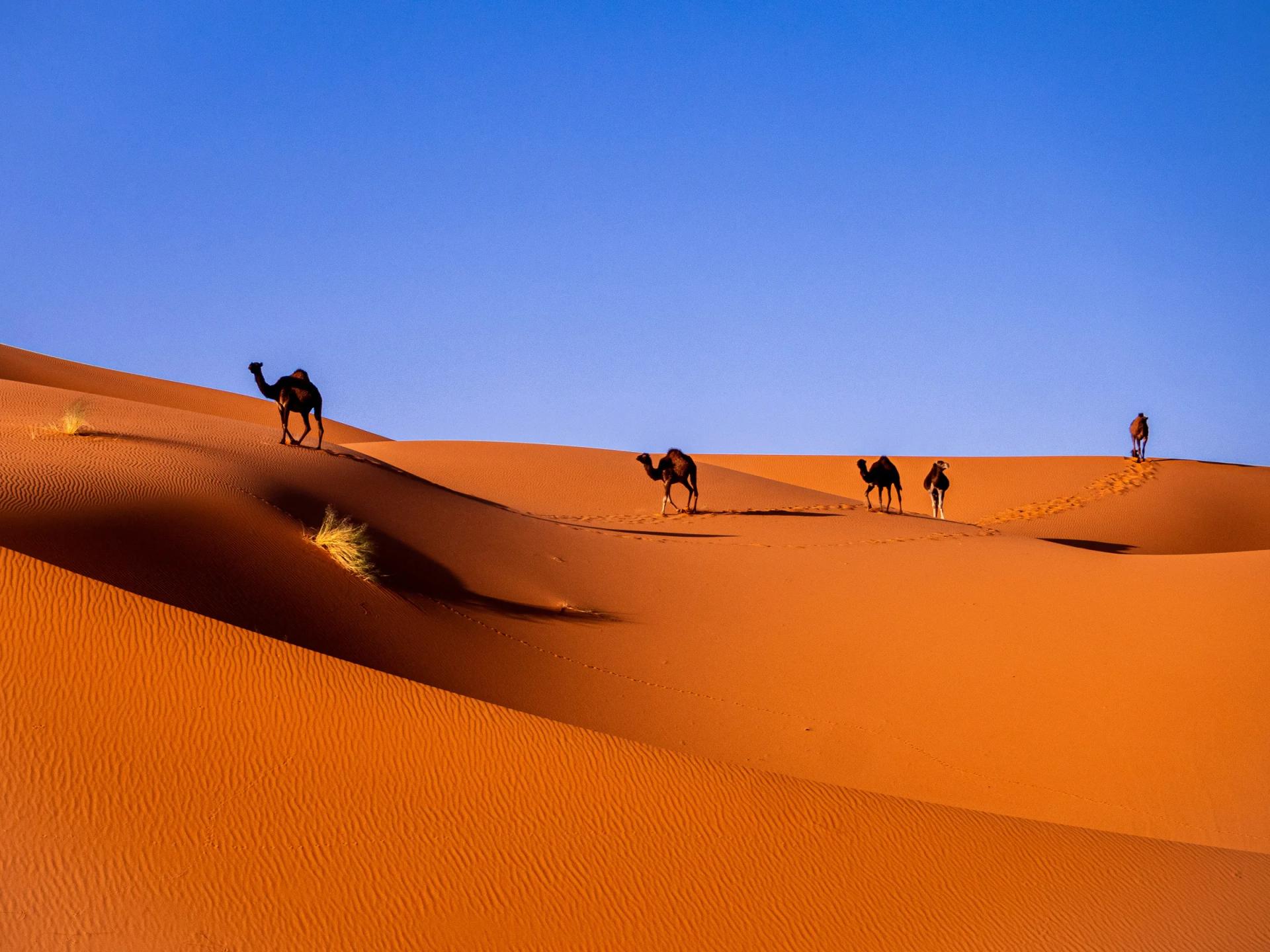
After an early breakfast we climb into the Middle Atlas Mountains, stopping first in Ifrane, an alpine-style town of chalets, gardens, and clean mountain air, often nicknamed "the Switzerland of Morocco." Nearby, in the cedar forests of Azrou, we pause among some of the oldest and tallest cedar trees in North Africa, where playful Barbary macaques, the only monkeys found north of the Sahara, can often be seen among the branches. The road then crosses high plateaus toward Midelt, a convenient lunch stop between the Middle and High Atlas, before descending through the dramatic Tizi n'Talghomt pass into the Ziz Valley, one of southern Morocco's most stunning sights: a river canyon filled with an unbroken ribbon of palm groves and earthen villages stretching toward the desert. We stop at panoramic viewpoints before the landscape opens into hammada (stone desert) and, finally, the towering orange dunes of Erg Chebbi rise on the horizon. In Merzouga, you will trade the vehicle for camels:
Luxury CampBreakfast - D7
Day 7 · Dades Valley
Day 7: Merzouga to Rissani, the Todra Gorges & Dades Valley
Rise before dawn for one of the great experiences of any Moroccan journey: sunrise over the Erg Chebbi dunes, as the sands shift from deep violet to burning gold. After breakfast at the camp, we return to Merzouga and drive to Rissani, the historic desert capital of the Tafilalet oasis, cradle of Morocco's ruling Alaouite dynasty and once the last caravan stop before the 52-day trans-Saharan crossing to Timbuktu. Its lively traditional market, where locals and nomads still trade dates, livestock, and handicrafts, offers an authentic glimpse of desert life. Continuing west along the ancient caravan routes, we reach the Todra Gorges, where sheer rock walls rise up to 300 meters on either side of a crystal-clear river, narrowing at points to just a few meters apart. Take a walk along the canyon floor between the towering cliffs, a favorite spot of rock climbers from around the world, before following the "Route of a Thousand Kasbahs" into the Dades Valley, a landscape of rose gardens.
GuesthouseBreakfast - D8
Day 8 · Ait Ben Haddou
Day 8: Dades Valley to Skoura, Ouarzazate & Ait Ben Haddou
After breakfast we continue along the legendary Road of a Thousand Kasbahs, passing through the rose-growing town of Kelaat M'Gouna, famous for its annual Rose Festival, and the vast Skoura palm oasis, dotted with crumbling ochre kasbahs among the date palms. We arrive in Ouarzazate, the "Hollywood of Africa," gateway to the Sahara and home to the famous Atlas Film Studios, where productions from Lawrence of Arabia to Gladiator and Game of Thrones have been filmed. You may visit the impressive Taourirt Kasbah, once a stronghold of the powerful Glaoui family.
GuesthouseBreakfast - D9
Day 9 · Marrakech
Day 9: Ait Ben Haddou to Marrakech via the Tizi n'Tichka Pass
After breakfast, and perhaps a final morning look at the ksar glowing in the early light, we begin the spectacular crossing of the High Atlas Mountains via the Tizi n'Tichka pass, which at 2,260 meters is the highest major road pass in North Africa. The winding road climbs through a constantly shifting panorama: ochre canyons, terraced Berber villages clinging to the hillsides, walnut and almond groves, and sweeping vistas over snow-dusted peaks. We make several scenic stops for photographs, and there may be time to visit a women's argan oil cooperative along the descent. By afternoon the road drops onto the Haouz plain and the palm-fringed skyline of Marrakech, the "Red City," comes into view. Settle into your riad or hotel, then venture out at your leisure. The evening spectacle of Jemaa el-Fnaa square, alive with food stalls, musicians, and storytellers, is the perfect first taste of the city.
RiadBreakfast - D10
Day 10 · END OF THE TOUR
Day 10: Marrakech Guided City Tour & Departure
After breakfast, discover the highlights of Marrakech with your local guide. Founded in 1062 by the Almoravid dynasty, the "Pearl of the South" has enchanted travelers for nearly a millennium. Visit the Bahia Palace, a late 19th-century masterpiece of Moroccan architecture whose name means "brilliance": a labyrinth of marble courtyards, painted cedar ceilings, and fragrant orange-tree gardens built for a grand vizier. Admire the Koutoubia Mosque, whose 77-meter minaret has dominated the city skyline since the 12th century and served as the model for the Giralda in Seville. Then plunge into the vibrant souks of the medina, a UNESCO World Heritage Site, where dyers, metalworkers, leather craftsmen, and spice sellers ply their trades much as they have for centuries, before emerging into the legendary Jemaa el-Fnaa square, a swirling open-air theater of snake charmers, henna artists, musicians, and storytellers recognized by UNESCO as a Masterpiece of the Intangible Heritage of Humanity.
Breakfast
What's included
- Accommodation with daily breakfast
- Private air-conditioned vehicle with an English-speaking driver
- Licensed local guides in the main cities
- All entrance fees for the included sites
- Camel trek and an overnight in a desert camp
- Private airport transfers (arrival and departure)
- 24/7 support during your trip
Not included
- International flights
- Lunches and most dinners
- Beverages
- Optional experiences
Frequently asked questions
Is this a private tour?+
Yes. It runs in a private air conditioned vehicle with your own driver and licensed local guides, and the itinerary is fully customizable.
Can the start and end city be changed?+
Yes. The itinerary is flexible and can be resequenced to start or finish at any Moroccan airport, around your flights.
Reviews
No reviews yet
Be the first to book this experience and leave a review!