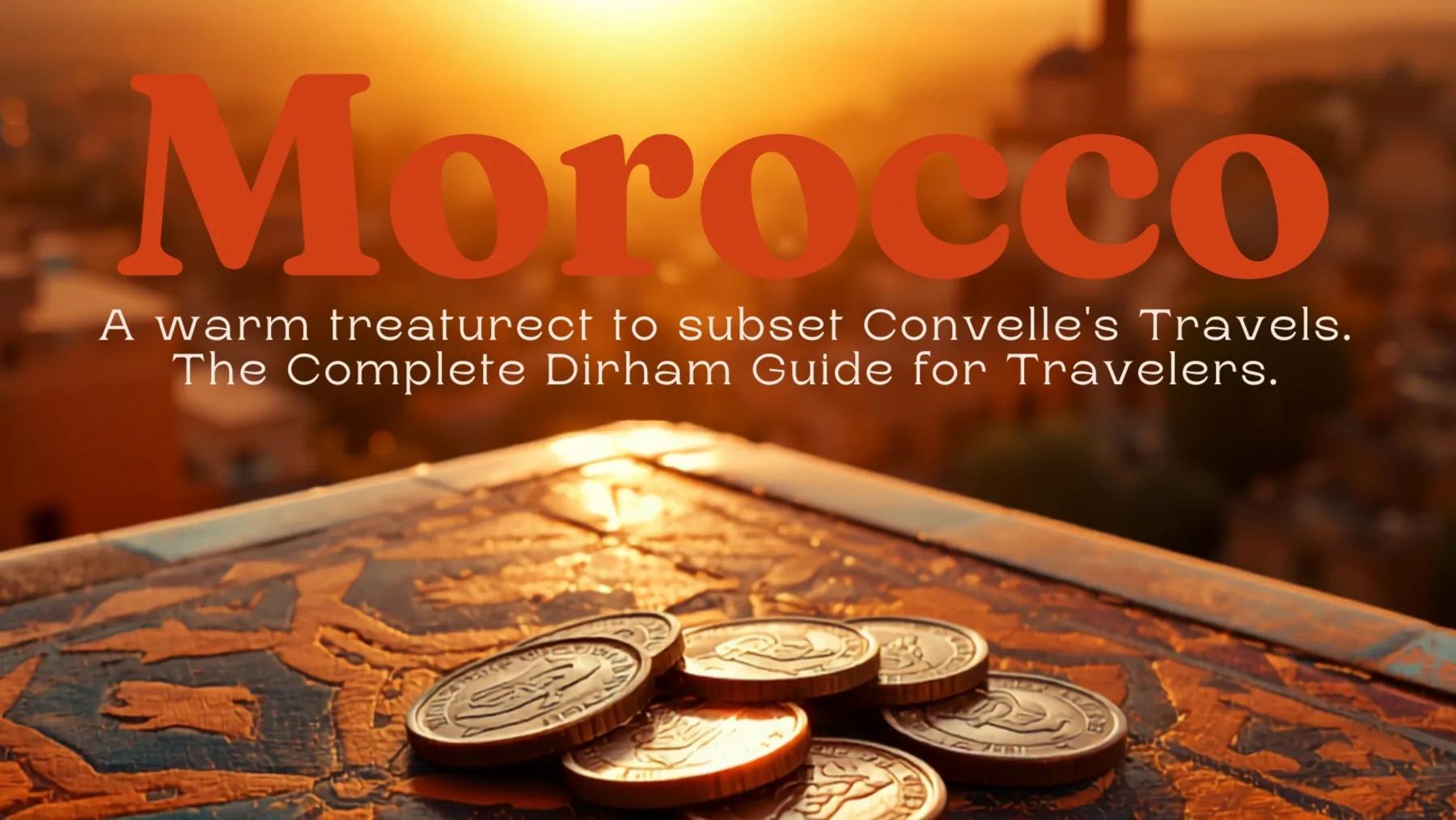
Morocco uses the Moroccan dirham, written MAD or DH. The dirham is divided into 100 centimes, though prices are almost always quoted in whole dirhams.
The unusual thing about the dirham is that it is a closed currency: you legally cannot import or export it. You will not find Moroccan dirhams at your bank back home, and travel cash services like Travelex generally do not stock them either. You exchange your dollars, euros, or pounds once you arrive in Morocco, not before.
This sounds inconvenient and is actually fine, because Morocco has airport exchange counters, in-city banks, and ubiquitous ATMs that all work for foreign cards.
Quick conversion rates (May 2026)
Approximate rates to keep in your head while shopping:
- 1 USD ≈ 10 MAD
- 1 EUR ≈ 10.8 MAD
- 1 GBP ≈ 12.5 MAD
- 1 CAD ≈ 7.3 MAD
For quick mental math, divide MAD by 10 to get rough USD, or divide by 11 for rough EUR. A 200 MAD tagine dinner is around 20 USD. A 50 MAD taxi ride is around 5 USD.
Exchange rates fluctuate. Check xe.com for live rates before your trip.
What dirhams look like
Bills come in 20, 50, 100, and 200 MAD. They are colorful and feature King Mohammed VI on the front, with cultural and architectural scenes on the back.
Coins come in half, 1, 2, 5, and 10 MAD, plus small centime coins you can ignore for most practical purposes.
A practical tip: the 200 MAD note is the largest and many small shops, taxis, and street vendors cannot break it. Try to keep a mix of 20s, 50s, and 100s for everyday spending.
Where to exchange money
In rough order of how good the rate is:
Best: ATMs in Moroccan cities
ATMs from BMCE, BMCI, Attijariwafa Bank, and Banque Populaire give you the official mid-market rate with a small bank-set markup, plus whatever fee your home bank charges (usually 3 to 5 USD per withdrawal).
If your debit card refunds ATM fees (Charles Schwab Visa, some European fintech cards, Revolut, Wise), this is essentially free.
Daily limits are typically 2,000 to 4,000 MAD per transaction. If you need more, do two withdrawals back to back.
Good: city exchange offices (bureaux de change)
Independent currency exchange offices in Casablanca, Marrakech, and other tourist cities post their rates publicly. The good ones are within 1 to 2% of the official rate. Bring your passport.
Acceptable: bank counters
Slower, lots of paperwork, but safe. Useful for larger amounts (over 5,000 MAD equivalent).
Worst: airport exchange counters
Airport bureaux de change typically take 8 to 12% off the rate. The convenience is real if you need cash for a taxi or SIM card on arrival, but exchange the minimum to get into the city (around 500 MAD) and use ATMs in town for the rest.
Avoid: hotel front desks and "friends in the medina"
Hotel exchange rates can be 15% off the official rate. The "friend who can change money for you" in the medina is either a scam or someone running unlicensed currency operations.
How much cash should you bring
Plan to use cards for hotels, restaurants in tourist districts, supermarkets, and bigger souk purchases. Use cash for:
- Taxis (most do not take cards)
- Small cafes and street food
- Tips (riad staff, guides, drivers)
- Souk haggling (cash gets better prices)
- Hammams, traditional shops, and rural restaurants
A reasonable rule of thumb: 300 to 500 MAD per person per day in cash, with the rest of your budget on card. For a one-week trip, withdrawing 2,500 to 3,500 MAD per person over the week handles most cash spending comfortably.
Cards: what works and what does not
Visa and Mastercard
Widely accepted in hotels, riads, mid-range and upscale restaurants, larger shops, supermarkets, and most experience operators. Always check before ordering: smaller places will say seulement especes (cash only).
American Express
Limited acceptance. Some luxury hotels and a few upscale restaurants take it. Do not rely on Amex as your only card.
Discover, UnionPay
Rarely accepted. Bring a Visa or Mastercard backup.
Apple Pay / Google Pay
Working in modern terminals in Casablanca, Marrakech, and Rabat at hotels, supermarkets, and chain restaurants. Patchy elsewhere. Not yet at most taxis or souk vendors.
Contactless
Increasingly common in cities. Tap-to-pay limits are usually around 400 MAD per transaction without PIN.
Cards we recommend for Morocco
- Charles Schwab Investor Checking (U.S.): refunds all foreign ATM fees, no foreign transaction fee. The single best card for Morocco.
- Wise (multi-currency debit, available in U.S./UK/EU): excellent ATM rates within monthly free limits, very transparent FX.
- Revolut (UK/EU): similar to Wise, with weekend FX surcharges to watch out for.
- Most travel rewards credit cards (Capital One Venture, Chase Sapphire, Barclaycard) charge no foreign transaction fee. Use these for swiping at hotels and restaurants.
Always decline the "pay in your home currency" option at restaurant terminals. The Moroccan dirham conversion is always better than the merchant rate.
Tipping in Morocco (how cash gets used)
Tipping is part of the economy. A few rough guides:
- Restaurants: Round up the bill, or leave 5 to 10% for good service. Some upscale places add a service charge already.
- Taxis: Round up to the next 5 or 10 MAD.
- Bag carriers at riads: 10 to 30 MAD.
- Local guides: 30 to 100 MAD per half day, 200 to 400 MAD per full day.
- Drivers (multi-day tours): 100 to 200 MAD per day.
- Hammam attendants: 30 to 50 MAD.
Keep a small stash of 10 and 20 MAD notes for tips. Breaking a 200 to tip 20 puts both you and the recipient in an awkward spot.
What to do with leftover dirhams
Because the dirham is closed, banks at home will not buy them back. Your options at the airport on the way out:
- Spend them. Airport restaurants, duty-free in some terminals.
- Exchange back to USD/EUR at the airport bureau de change (you can convert up to 50% of what you originally exchanged, with the receipt). The rate is bad.
- Keep them for your next trip, or give them to a returning friend.
- Donate them to one of the charity collection boxes at Casablanca and Marrakech airports.
Plan ahead: try to end your trip with under 300 MAD in cash.
What if everything goes wrong
If your card is swallowed by an ATM, your bank back home is your first call. The Moroccan bank will typically cancel the card and require you to pick it up in person at the branch the next business day.
If your wallet is stolen, file a police report (for insurance) and contact your embassy if your passport was in it. The U.S. Embassy in Rabat can issue emergency replacement passports usually within a day.
Western Union has branches in every Moroccan city if a family member needs to wire you emergency funds.
FAQ
What currency is used in Morocco
The Moroccan dirham, written MAD or DH. It is divided into 100 centimes but prices are almost always quoted in whole dirhams.
Can I buy Moroccan dirhams before my trip
No. The dirham is a closed currency that cannot legally be imported or exported. You exchange your home currency once you arrive in Morocco, typically at an ATM in the city.
How much is 1 US dollar in Moroccan dirhams
Roughly 10 MAD as of May 2026, though rates fluctuate. For quick math, divide MAD prices by 10 to estimate USD.
Are credit cards accepted in Morocco
Visa and Mastercard work at hotels, riads, mid-range restaurants, larger shops, and supermarkets in cities. American Express has limited acceptance. Smaller cafes, taxis, and souk vendors are cash-only.
What is the best way to exchange money in Morocco
ATMs from major Moroccan banks (BMCE, Attijariwafa, Banque Populaire) give the closest rate to mid-market. Avoid airport exchange counters and hotel front desks, which can be 8 to 15% off.
How much cash should I bring to Morocco
Bring 100 to 200 USD worth of your home currency as backup, but plan to withdraw most cash from ATMs in Morocco. Budget 300 to 500 MAD per person per day in cash for taxis, tips, and small purchases.
Can I use US dollars in Morocco
Generally no. A few high-end tourist shops and Sahara desert tour operators accept dollars or euros, but the rate is bad. Always pay in dirhams.
Are there ATMs in Morocco
Yes, in every city and most large towns. They accept Visa, Mastercard, and most international debit cards. Daily withdrawal limits are typically 2,000 to 4,000 MAD per transaction.
What if I have dirhams left at the end of my trip
Spend them at the airport, exchange them back at the bureau de change with your original exchange receipt (limited to 50% of what you originally bought), or save them for a future trip.